Choosing the right oil-filled radiator is paramount for achieving optimal warmth and energy efficiency in your home. With various models flooding the market, a common point of contention arises: the number of fins. While seemingly a minor detail, the fin count, particularly comparing 5-fin and 7-fin models, significantly impacts a radiator’s heating power, its ability to distribute warmth evenly, and its overall suitability for different spaces. This guide will demystify the role of fins, offering expert insights to help you select the perfect oil-filled radiator for your specific heating needs.
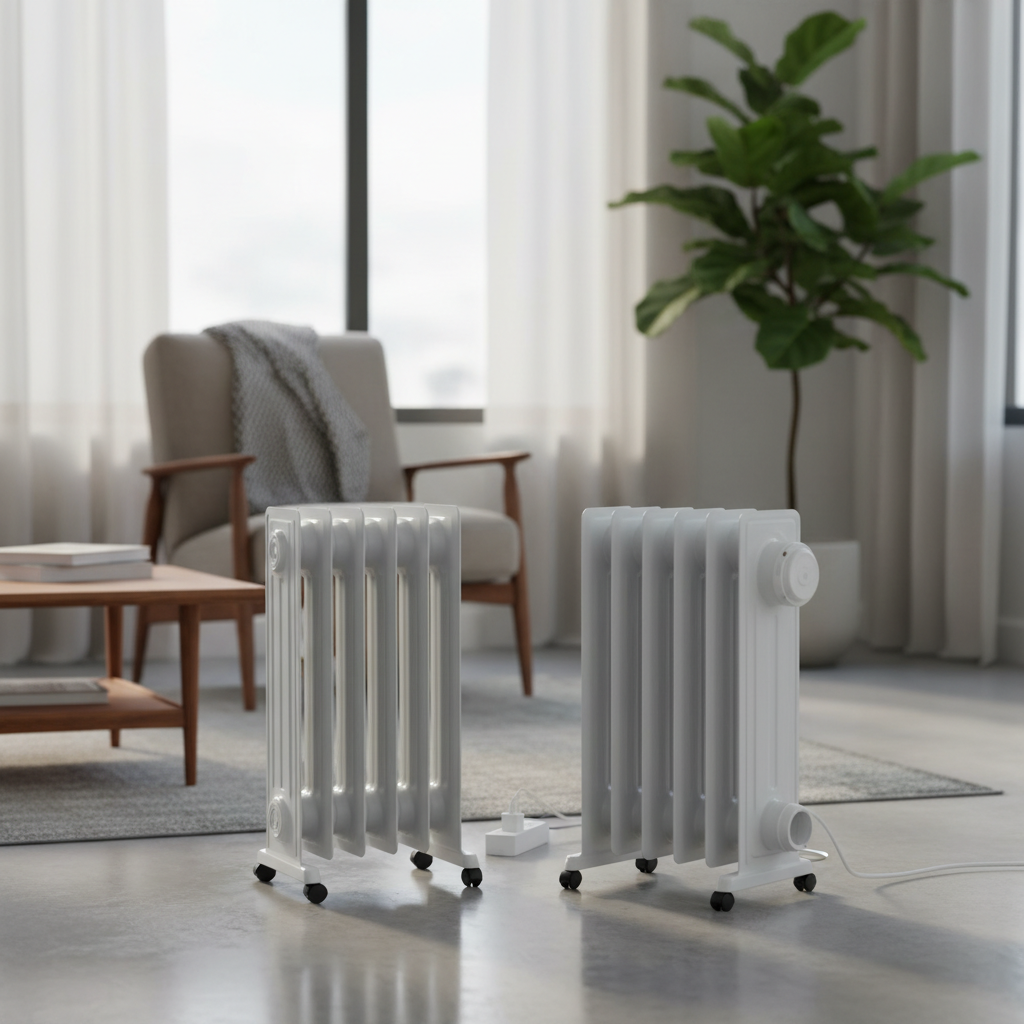
The Science Behind Oil-Filled Radiators and Fins
Oil-filled radiators operate on a simple yet effective principle. An electric heating element submerged in diathermic oil warms the liquid, which then circulates throughout the sealed metal columns or “fins” of the radiator. These heaters primarily use two methods to warm a room: convection and radiation. Convection involves heating the air directly in front of the unit, which then rises and circulates, displacing cooler air. Radiation, on the other hand, directly warms objects and people in the room, offering a more efficient form of heating.
The distinctive design featuring multiple fins is not merely aesthetic; it’s a critical engineering choice. Fins are essentially metal plates attached to the oil chamber, drastically increasing the total surface area of the radiator. This larger surface area allows for significantly greater contact with the surrounding air, which is fundamental for efficient heat transfer through convection. The more surface area available, the more effectively the heat from the warmed oil can be dissipated into your room, impacting both how quickly and how evenly your space gets warm.
5-Fin vs. 7-Fin: Unpacking the Differences in Heating Performance
When comparing 5-fin and 7-fin oil-filled radiators, the distinction lies not in the amount of heat produced, but in the efficiency and manner of its distribution. The number of fins plays a pivotal role in determining how quickly a room reaches a comfortable temperature and how uniformly that warmth is maintained.
Surface Area and Heat Dispersion
|
Our Picks for the Best Oil filled radiator in 2026
As an Amazon Associate I earn from qualifying purchases.
|
||
| Num | Product | Action |
|---|---|---|
| 1 | Amazon Basics Portable Oil Radiator Heater, Indoor Use, 3 Heat Settings, Over-Heat Protection, ETL-certified Safety, 7 Oil-Filled Steel Fins, 1500W, Tip-Over Protection, 11"D x 14.8"W x 25.2"H, White |

|
| 2 | Pelonis Oil Filled Radiator Heater for Large Space, 2025 Upgraded, Space Heaters with 1500W Quiet Warmth Radiant Heater, 3 Heating Modes, Overheat & Tip-Over Protection, Adjustable Thermostat, Black |
|
| 3 | Amazon Basics Portable Oil Space Heater with 7 Oil-Filled Fins, 3 Heat Settings, Adjustable Thermostat, Tip-Over and Overheat Protection, ETL Safety Certificate, 1500W, Black |
|
| 4 | Pelonis Oil Filled Radiator Heater for Large Space, 2025 Upgraded, Space Heaters with 1500W Quiet Warmth Radiant Heater, 3 Heating Modes, Overheat & Tip-Over Protection, Adjustable Thermostat, White |
|
| 5 | PELONIS Radiator Heater for Large Space, Electric Oil Filled Radiator, Dual Knobs, 1500W, Quiet Space Heater, 3 Modes, Tip-over Protection |
|
| 6 | PELONIS Oil Filled Radiator, Electric Space Heater for Indoor Use Large Room with Thermostat & Remote, 3 Modes & 3 Heat Settings, ECO Mode, 24H Timer, Quiet, Overheat & Tip-Over Protection, 1500W |
|
| 7 | DREO Oil Filled Radiator, Electric Radiant Heaters for indoor use Large Room with Remote Control, Child Lock, 4 Modes, Overheat & Tip-Over Protection, 24h Timer, Digital Thermostat, Quiet, 1500W |
|
| 8 | PELONIS Radiator Heater for indoor use Large Room with Remote, Thermostat & LED Display, Quiet Oil Filled Heater with 5 Temperature Settings, Overheat & Tip-Over Protection, Silver |
|
| 9 | Amazon Basics Portable Oil Space Heater with Remote Control, 7 Oil-Filled Fins, Adjustable Thermostat, 3 Heat Settings, Tip-Over and Overheat Protection, ETL Safety Certificate, 1500W, Black |
|
| 10 | PELONIS Radiator Heater for Large Space, Electric Oil Filled Radiator, Dual Knobs, 1500W, Quiet Space Heater, 3 Modes, Tip-over Protection |
|
The most direct difference between a 5-fin and a 7-fin oil-filled radiator is the total surface area. A 7-fin model inherently offers more surface area than its 5-fin counterpart. This increased surface area is crucial because it allows for more contact points between the heated metal and the ambient air. As a result, 7-fin radiators are generally capable of faster heat dissipation and a wider spread of warmth across a given space.
For instance, studies comparing radiators with more fins (e.g., 13 vs. 17 fins) show that a higher fin count leads to significantly reduced warm-up times and a larger heat spread radius. While a 13-fin radiator might take over two hours to reach a stable room temperature, a 17-fin model could achieve the same comfort level in about an hour, distributing heat across a much wider area. This principle scales down to 5-fin and 7-fin comparisons, suggesting that a 7-fin model will typically warm a room more quickly and uniformly than a 5-fin unit, assuming comparable wattage.
Wattage, Not Fins, Determines Total Heat Output
It is vital to understand that the total heating power, measured in watts, is primarily determined by the radiator’s electrical heating element, not the number of fins. All electric heaters, including oil-filled radiators, convert nearly 100% of the electrical energy consumed into heat. Therefore, a 1500W 5-fin radiator and a 1500W 7-fin radiator will produce the exact same amount of total heat.
The fin count, however, dictates how efficiently and effectively that heat is transferred from the internal oil to the room. While both units may generate 1500W of heat, the 7-fin model, with its larger surface area, will distribute that heat more rapidly and broadly, making the room feel warmer sooner and more consistently.
Warm-Up Time and Evenness
Thanks to their enhanced surface area, 7-fin oil-filled radiators typically boast faster warm-up times. The larger radiating surface allows more heat to escape into the room at any given moment, accelerating the convection process and helping the space reach its desired temperature more quickly. Furthermore, the increased surface area contributes to more even heat distribution throughout the room, reducing cold spots and providing a more consistent level of comfort.
An interesting byproduct of increased fin count is a potentially lower peak surface temperature per individual fin for the same overall heat output. This can translate to a safer operation, reducing the risk of accidental burns and minimizing the common “dust-burning” smell associated with some heaters.
Matching Fin Count to Your Space: A Practical Buying Guide
Choosing between a 5-fin and a 7-fin oil-filled radiator depends largely on the specific characteristics of the room you intend to heat and your heating priorities.
Ideal Scenarios for 5-Fin Oil-Filled Radiators
5-fin oil-filled radiators are generally more compact and can be an excellent choice for smaller to medium-sized rooms, typically up to 15 square meters. They are particularly well-suited for spaces where floor area is at a premium, such as a cozy home office, a small bedroom, or even a utility room. Their smaller footprint makes them easy to position and store. While they may take a bit longer to warm up a space compared to a 7-fin model of similar wattage, they still provide effective and consistent warmth, especially when used for supplemental heating in areas that are already partially warmed.
Advantages of 7-Fin Oil-Filled Radiators
7-fin oil-filled radiators offer increased versatility and performance, making them suitable for a broader range of applications. These models are ideal for medium to larger rooms, extending their effectiveness to areas up to approximately 20 square meters. They are particularly effective in high-airflow rooms like kitchens or living rooms, where quicker and more uniform heating is often desired.
Moreover, even for very small rooms (e.g., 6 square meters), a 7-fin model with appropriate wattage (such as a 600W unit) can provide optimal heat distribution within a minimal space. If rapid heating and consistent warmth throughout the room are your top priorities, a 7-fin radiator often delivers superior performance.
Beyond Fin Count: Wattage and Other Features
While fin count is important for heat distribution, it should always be considered in conjunction with the radiator’s wattage, which directly correlates to the total heat output. Always match the wattage to your room size for effective heating.
Beyond the fins, look for features that enhance usability and safety. A reliable thermostat control is essential for maintaining a consistent temperature and preventing overheating. Timer functions allow you to schedule operation, saving energy by only heating when needed. Safety features like tip-over sensors and overheat protection are crucial for peace of mind. Some modern radiators also incorporate advanced fin shapes, such as wave-shaped designs, which can further optimize heat transfer by increasing surface area.
Maximizing Your Oil-Filled Radiator’s Efficiency
To get the most out of your oil-filled radiator, regardless of its fin count, proper usage and maintenance are key.
Firstly, strategic placement is crucial. Ensure your radiator is positioned in an open area, away from obstructions like furniture, curtains, or shelves, to allow for unobstructed airflow. This maximizes the natural convection process and heat distribution. Running a radiator directly under a window can help counteract cold drafts.
Secondly, utilize your radiator’s thermostat effectively. Instead of running it on the highest setting continuously, set the thermostat to your desired comfortable temperature. The radiator will then cycle on and off to maintain this warmth, preventing overheating and unnecessary energy consumption. Many modern units also come with programmable timers, allowing you to heat your space only when occupied, further optimizing energy use.
Finally, regular cleaning is essential. Over time, dust and debris can accumulate between the fins, impeding airflow and reducing the radiator’s thermal efficiency. A quick wipe-down or vacuuming of the fins periodically will help maintain optimal performance.
Conclusion
The choice between a 5-fin and a 7-fin oil-filled radiator boils down to understanding how fin count influences heat distribution and warm-up time, rather than total heat output. While wattage dictates the overall heating power, a higher fin count, such as 7 fins, generally offers a larger surface area, leading to faster heat dispersion, more even room temperatures, and potentially greater operational efficiency. Conversely, 5-fin models remain a compact and effective solution for smaller rooms or supplemental heating needs. By aligning your selection with your room size, desired heating speed, and considering essential features, you can confidently choose an oil-filled radiator that provides optimal comfort and warmth for your home. Which fin count best aligns with your personal heating philosophy?
Câu Hỏi Thường Gặp
Do more fins mean more electricity consumption?
No, the number of fins does not directly increase electricity consumption. The wattage of the radiator is the primary factor determining how much electricity it uses. More fins improve the efficiency of heat distribution, allowing the room to warm up faster and more evenly, which can indirectly lead to energy savings if the heater cycles off sooner or maintains temperature at a lower setting.
Which is better for a bedroom: 5-fin or 7-fin?
For a bedroom, a 7-fin radiator (especially around 1500-2000W, depending on room size) is often better as it provides faster and more even heat distribution, contributing to a more consistent and comfortable sleeping environment. A 5-fin model might suffice for very small bedrooms or if space is extremely limited, but the 7-fin generally offers superior performance.
Can I use a 5-fin radiator in a large living room?
While a 5-fin radiator can provide some supplemental heat, it is generally not recommended as the sole heating source for a large living room. Its limited surface area would struggle to effectively and evenly heat a spacious area, leading to longer warm-up times and potential cold spots. For larger rooms, a radiator with more fins and higher wattage (e.g., a 7-fin, 9-fin, or even 11-fin model with 2000W or more) would be more appropriate.
How quickly do oil-filled radiators heat a room?
Oil-filled radiators are known for their gradual, sustained heat rather than instant warmth. Generally, they can take 30-60 minutes to noticeably warm a room. Models with a higher fin count, like a 7-fin, tend to achieve stable room temperatures faster and distribute heat more widely compared to those with fewer fins.
